On this page
Tau: The Open-Source Agent You Read Like a Textbook
HuggingFace's Tau is the first coding agent built to be understood. Its 200-line loop confirms what I suspected after 2+ years inside Claude Code, Cursor, and Codex: the architecture is universal, the magic is in the harness.
I’ve been living inside terminal coding agents for over two years now. Claude Code is my daily driver. Cursor for rapid prototyping when I need visual context. Codex for parallelized background tasks. I’ve written about how Claude Code works, analyzed the leaked source, and built a thesis around harness engineering as the real differentiator.
But I’d never seen a production-quality agent built to be read.
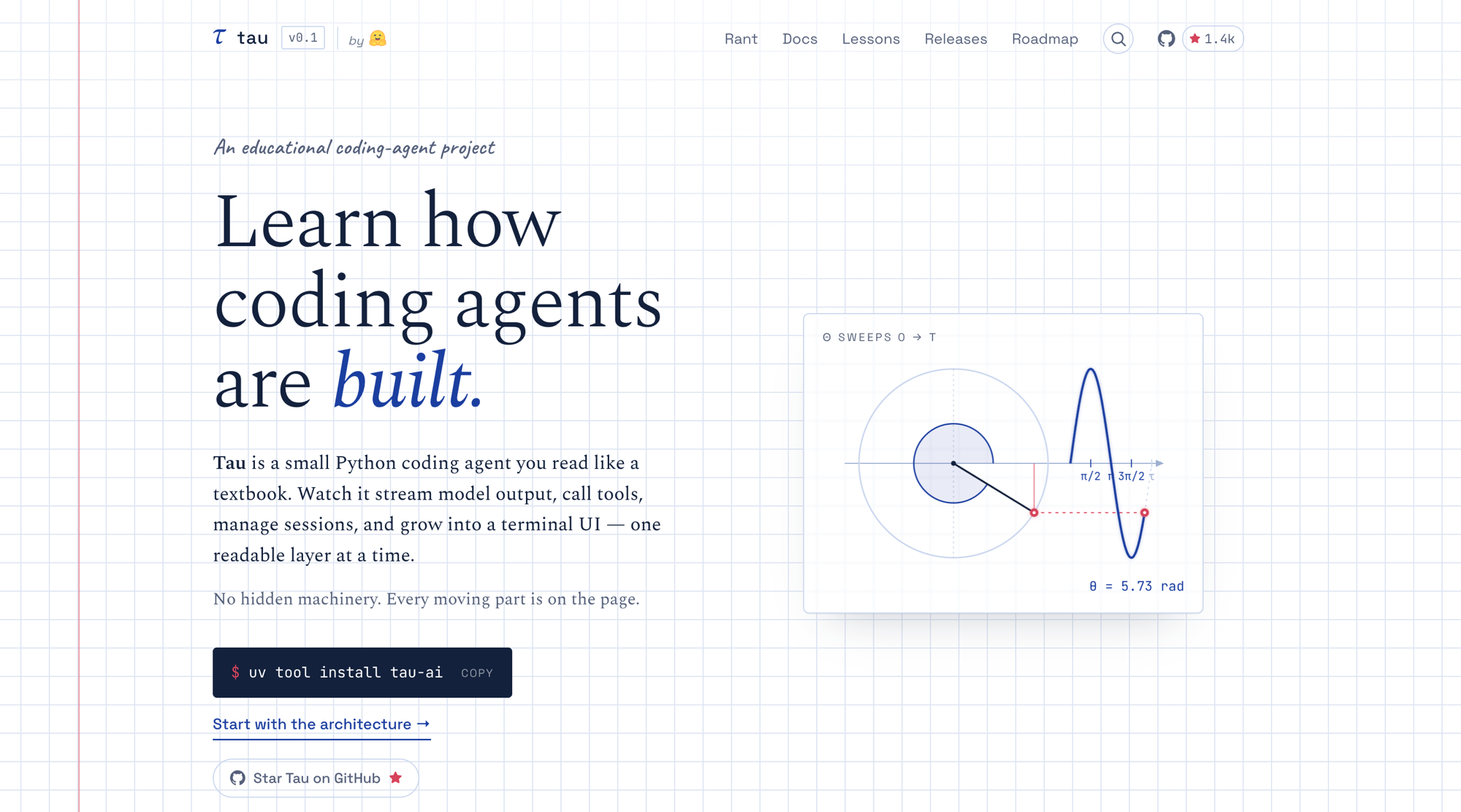
Tau is a Python coding agent from HuggingFace that prioritizes being understood over being feature-complete:
No hidden machinery. Every moving part is on the page.
The name is a math joke with teeth. The project is named after the circle constant τ (tau = 2π) and directly inspired by Pi, another minimalist coding-agent harness. The argument: π is “technically correct but centered on the wrong thing, so simple ideas end up looking complicated.” Tau’s thesis is the same applied to agent architecture. Find the honest core, build outward, make the rest obvious.
After a weekend with the source, I can confirm: this is the clearest X-ray of a coding agent available today. And it validates what I’ve suspected for a while. The architecture underneath Claude Code, Cursor, Codex, and Tau is identical. The differences are purely in harness quality.
The Universal Three-Layer Split
Every terminal coding agent I’ve used follows the same architecture. Tau names the layers explicitly:
%%{init: {"layout": "dagre"}}%%
flowchart TD
    subgraph tau_ai["tau_ai — Provider Layer"]
        A[OpenAI / Anthropic / Codex / Local]
        B[Provider-neutral event stream]
    end
    subgraph tau_agent["tau_agent — Portable Brain"]
        C[Agent Loop]
        D[Tool Execution]
        E[Session Tree]
        F[Event System]
    end
    subgraph tau_coding["tau_coding — Application Shell"]
        G[CLI / TUI]
        H[File Tools: read, write, edit, bash]
        I[Project Context / Skills]
        J[Provider Config]
    end
    A --> B
    B --> C
    C --> D
    C --> F
    D --> E
    F --> G
    J --> A
    H --> D
    I --> C
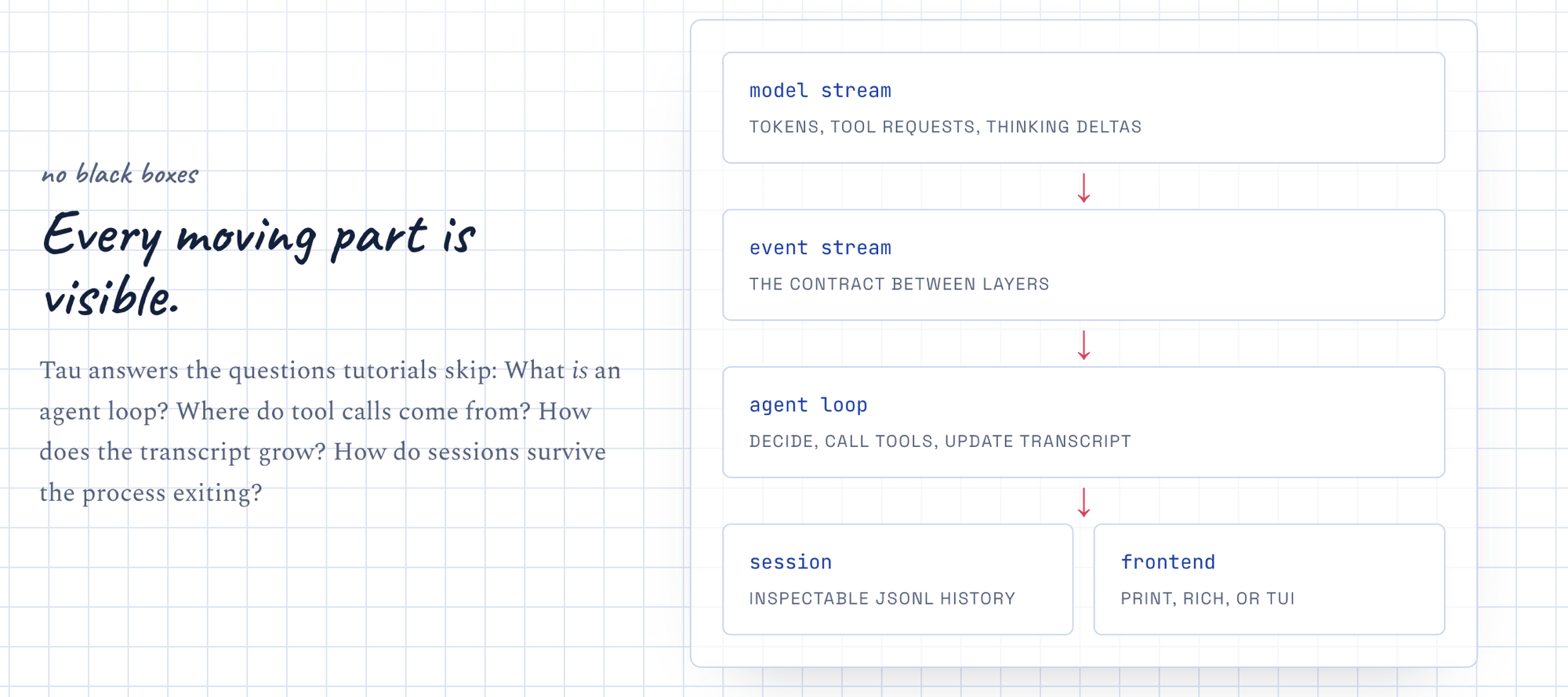
Tau’s own documentation visualizes this as a pipeline of five concerns:
| Layer | Knows About | Doesn’t Know About |
|---|---|---|
tau_ai (provider) | HTTP streams, auth, SSE parsing | Tools, files, UI, sessions |
tau_agent (brain) | Messages, events, tool dispatch | Terminals, config files, commands |
tau_coding (app) | Everything above + CLI, TUI, disk | Nothing is hidden from it |
This isn’t a choice among alternatives. Claude Code, Cursor’s agent mode, Codex CLI, Windsurf. All follow this split. The difference is how much engineering goes into each layer.
The 200-Line Core
The entire agent brain fits in src/tau_agent/loop.py:
%%{init: {"layout": "dagre"}}%%
flowchart LR
    A[User prompt] --> B[Send to model]
    B --> C{Tool calls?}
    C -->|yes| D[Execute tools]
    D --> E[Append results]
    E --> B
    C -->|no| F[Return response]
In code:
async def run_agent_loop(*, provider, model, system, messages, tools):
    yield AgentStartEvent()
    while True:
        async for event in provider.stream_response(
            model=model, system=system, messages=messages, tools=tools
        ):
            yield convert_to_agent_event(event)

        if assistant_message.tool_calls:
            for tool_call in assistant_message.tool_calls:
                result = await execute_tool(tool_call)
                messages.append(tool_result_message(result))
        else:
            break

    yield AgentEndEvent()
Under 200 lines with error handling, cancellation, retries, and steering queues. No orchestration framework. No workflow engine. No graph database.
The model’s next-token prediction IS the planning. There’s no planner module. No task queue. No goal decomposition engine. Just a loop that keeps calling the model until the model says “I’m done.”
Events: The Contract Between Everything
The second architectural truth Tau makes visible: everything communicates through typed events.
AgentStartEvent         → run begins
MessageDeltaEvent       → streamed text chunk
ToolExecutionStartEvent → tool about to fire
ToolExecutionEndEvent   → tool finished, result attached
ThinkingDeltaEvent      → model reasoning (optional)
ErrorEvent              → something broke
AgentEndEvent           → run complete
This is why Claude Code can simultaneously show streaming text, tool call cards, a sidebar with context usage, and an activity indicator. They’re not different systems. They’re different renderers on the same event stream.
Tau proves this by running three completely different frontends from identical events:
| Frontend | How It Renders | Use Case |
|---|---|---|
| Print mode | Final text to stdout | Scripts, pipes, CI |
| Rich renderer | Colored transcript to terminal | Quick debugging |
| Textual TUI | Full interactive app | Daily use |
Same events. Same brain. Three completely different user experiences.
Four Tools Run Everything
A tool in every coding agent I’ve studied:
@dataclass(frozen=True, slots=True)
class AgentTool:
    name: str                              # "read", "write", "edit", "bash"
    description: str                       # what the model reads
    input_schema: Mapping[str, JSONValue]  # JSON Schema for arguments
    executor: ToolExecutor                 # async function that runs
The model sees the schema. It decides whether to call the tool. The loop executes the function. That’s the entire contract.
| Tool | What It Does | The Constraint That Matters |
|---|---|---|
read | Read files, with offset/limit | Truncates at 2,000 lines or 50KB |
write | Create or overwrite files | Serialized per-path to prevent interleaving |
edit | Exact text replacements | Every oldText must match exactly once |
bash | Run shell commands | Kills process group on timeout |
Four tools. That’s the entire capability surface for a coding agent. When I first realized Claude Code had the same four, it reframed how I think about tool design:
You don’t need more tools. You need these four to be extremely reliable. One flaky edit tool causes more failures than a missing “search” tool.
Sessions: Append-Only Trees (Not Chat Logs)
This was the insight that connected the most dots for me. Session persistence isn’t a flat chat log. It’s a tree:
%%{init: {"layout": "dagre"}}%%
graph TD
    A[session_info] --> B[user: explain this module]
    B --> C[assistant: reads files, explains]
    C --> D[user: refactor the auth]
    D --> E[assistant: edits files]
    E --> F[compaction: summary of above]
    F --> G[user: now add tests]
    D --> H[branch_summary: abandoned approach]
    H --> I[user: different refactor idea]
Every entry has an id and a parent_id. Nothing is ever deleted. Compaction adds a summary that replaces older messages during replay without touching the file. Branching just points a leaf at a different ancestor.
This explains behaviors I’d noticed across all three agents I use daily:
| Behavior | Mechanical Cause |
|---|---|
| Resuming a session “feels different” | System prompt rebuilt from current config, not restored from snapshot |
| Context doesn’t grow linearly | Automatic compaction summarizes older messages at threshold |
| Branching from history works | Tree structure makes any entry a valid branch point |
| Agent “forgets” earlier decisions | Compacted messages are summaries, not originals |
The compaction threshold:
effective_limit = model_context_window - 16,384 reserve tokensWhen the estimate exceeds this, older messages get summarized. The originals stay in the file forever (for auditing, branching), but the model only sees the summary going forward.
What This Means If You’re Building Agents
Tau isn’t just a coding agent. It’s a validated blueprint for the agent pattern. The architecture works for any domain where an LLM needs to take actions and observe results.
Copy These Patterns
| Pattern | Why It Works | What Breaks Without It |
|---|---|---|
| Three-layer split | Testable, portable, swappable providers | Provider change = rewrite everything |
| Events as contract | Multiple frontends, observability, testing | Tight coupling, untestable loops |
| Append-only sessions | Branching, auditing, corruption recovery | Silent state loss, no undo |
| Isolated tool executors | Graceful failure, easy to add new tools | One broken tool crashes the agent |
Be Cautious About These
“I can build this in a weekend.” You can build the loop in a weekend. You cannot build reliable session persistence, graceful cancellation, context management, provider retry logic, tool error recovery, and useful system prompts in a weekend. That’s months.
Same model, bare loop = broken output in 20 minutes. Same model, full harness = working product in 6 hours at $200. That’s Anthropic’s own experiment.
No planning engine is a deliberate choice. This works for coding because the feedback loop is tight (run tests, see errors, fix). For domains with expensive feedback (staging deploys, 4-hour data pipelines), you need explicit planning because the model can’t afford to iterate 15 times.
Context window is physics, not a bug. When older messages get compacted, the model works from a summary. It will lose details from 50 turns ago. If your agent needs to remember specific early decisions, you need external memory. The session tree stores everything, but the model only sees the active path.
Extensions are Phase 21. That order is deliberate. Tau hasn’t built its plugin system yet. The core needs to be solid before extensibility. If you’re thinking about plugins before your session persistence works, you’re in the wrong phase.
What You’d Add for Production
| Gap | Why It Matters | Domain Example |
|---|---|---|
| Guardrails | Catching when the agent is wrong before it acts | Financial logic, data mutations |
| Structured planning | Breaking complex tasks into verifiable steps | Multi-file refactors, migrations |
| Human-in-the-loop gates | Stopping before destructive actions | Production deploys, data deletes |
| Cost controls | Preventing runaway sessions | $200 sessions that produce nothing |
| Parallel tool execution | Running independent tools concurrently | Reading 5 files at once |
My Take After 2+ Years
Reading Tau’s source confirmed something I’ve been circling:
The agent loop is a solved problem. The competitive surface has moved entirely to the harness.
When Claude Code outperforms Cursor on a complex refactoring task, it’s not because the loop is better. It’s because the context engineering is better. The system prompt is more precise. The tool implementations handle edge cases. The session persistence survives interruptions gracefully.
Tau makes this visible. When you see that the brain is 200 lines and the harness is thousands, you understand where the value lives.
For anyone building agents, the lesson is: stop optimizing the loop. Start optimizing the environment your loop runs in. Tools, context, persistence, system prompts, error recovery. That’s where every production failure I’ve encountered was actually caused.
Getting Started
git clone https://github.com/huggingface/tau.git
cd tau
Read path: dev-notes/design/01-architecture.md → src/tau_agent/loop.py → src/tau_coding/tools.py
The whole portable brain is ~500 lines across four files. You can read it in an hour. The documentation site has a structured walkthrough if you prefer guided reading over source diving.
To actually use it:
uv tool install tau-ai
tau
/login
Supports OpenAI, Anthropic, Codex, OpenRouter, HuggingFace, and any OpenAI-compatible endpoint including local models.
The Bottom Line
Tau doesn’t exist to replace Claude Code or Cursor. It exists to show you what they are. A loop, four tools, a session tree, and an event stream. The architecture is universal. The differentiation is in the harness surrounding that universal core.
If you’ve been building agents by trial and error, Tau gives you the map. If you’ve been using agents without understanding why they sometimes lose context or forget earlier decisions, Tau shows you the mechanical cause. If you’re evaluating whether to build your own agent harness or use an existing one, Tau shows you exactly what “existing one” means at the implementation level.
Building agents or exploring the architecture? I’d love to hear what patterns are working for you. Reach out on LinkedIn.